

Digital Program

About the
Power Plays Festival
poor players productions founders Erik Schiller and Kate McDuffie discuss the genesis and intention behind the Power Plays Festival, a project partially funded by the Independent Productions Initiative.
Watch the video and read the transcript below.
Erik
The original concept for this festival was inspired by the America 250 celebrations happening this year.
We really felt that there was a need in this time to focus on the aspects of our country’s history that we tend not to talk about as much.
We felt there was a real hunger right now to reckon with our country’s problems and the rise of authoritarianism.
And also reflect, too, about our relationship to our country and whether or not our actions are really aligned with our values.
So we’re producing 2, 1-act plays: Drunk Enough to Say I Love You? by Caryl Churchill and Protest by Václav Havel. Both of these plays depict characters in situations where they have to make a decision about whether or not to comply with authority.
Kate
We have also programmed 3 hands-on workshops as a part of this festival that will give people the opportunity to make something themselves while exploring the issues that matter most to them, whether that is through creating a zine, a collaborating on a devised scene, or by creating a protest poster that will serve as a part of our set and a backdrop of the festival.
We really hope that this festival will encourage anyone who attends to take action — beyond the walls of the theatre — to be a better neighbor and protect our communities and our collective futures.
We really look forward to seeing you July 31st-August 2nd at the Jarvis Square Theater in Rogers Park for the Power Plays Festival!
Erik
See you all there.

Program Notes + Profiles
Drunk Enough To Say I Love You?
by Caryl Churchill
Directed by Iris Sowlat
Lighting design by Charlotte Brown
Sound design by Kate McDuffie
Stage Manager Sofia Matza
Fight Choreographer XXX XXX
CAST (alphabetical order)
SAM, Leo Lacamera
GUY, Erik Schiller
Protest
by Václav Havel
Translation by Vera Blackwell
Directed by Erik Schiller
Lighting design by Charlotte Brown
Sound design by Kate McDuffie
Stage Manager Sofia Matza
CAST (alphabetical order)
VANEK, Sandia Coleman
STANEK, Kate McDuffie
Drunk Enough to Say I Love You?
by Caryl Churchill
Director’s Note
by Iris Sowlat
by Iris Sowlat
Overview
by Erik Schiller
In 2005, British playwright Harold Pinter was awarded the Nobel Prize in Literature. Pinter was hospitalized at the time, so couldn’t attend the ceremonies in Stockholm, but he made a prerecorded video of his acceptance speech, “Art, Truth, and Politics” which can be viewed here.
Sitting in a wheelchair, his distinctively deep voice hoarse but powerful, Pinter began by musing on the strange nature of truth in art, “You never quite find it but the search for it is compulsive. The search is clearly what drives the endeavor. The search is your task. ” After citing some examples of this “elusive” quality in his own work, he then moves on to the problem of truth in politics. He argues that, while the discovery of the “Truth” through dramatic language is crucial but always slightly out of reach, in politics, the objective is always to obscure truth. As an example, he presents the case of the US Invasion of Iraq which had happened two years earlier. “The justification for the invasion of Iraq was that Saddam Hussein possessed a highly dangerous body of weapons of mass destruction…. We were assured that was true. It was not true.” Pinter then begins to take us back further in time, stating that he would like to look at recent history, “by which I mean United States foreign policy since the end of the Second World War”:
Everyone knows what happened in the Soviet Union and throughout Eastern Europe during the post-war period: the systematic brutality, the widespread atrocities, the ruthless suppression of independent thought. All this has been fully documented and verified.,
But my contention here is that the US crimes in the same period have only been superficially recorded, let alone documented, let alone acknowledged, let alone recognized as crimes at all. I believe this must be addressed and that the truth has considerable bearing on where the world stands now…
What he said next sparked controversy on both sides of the Atlantic. “The United States supported and in many cases engendered every right wing military dictatorship in the world after the end of the Second World War.” He lists the following countries: “Greece, Uruguay, Brazil, Paraguay, Haiti, Turkey, the Philippines, Guatemala, El Salvador, Chile.”
Hundreds of thousands of deaths took place throughout these countries. Did they take place? And are they in all cases attributable to US foreign policy? The answer is yes, they did take place and they are attributable to American foreign policy. But you wouldn’t know it.
It never happened. Nothing ever happened. Even while it was happening it wasn’t happening. It didn’t matter. It was of no interest. The crimes of the United States have been systematic, constant, vicious, remorseless, but very few people have actually talked about them. You have to hand it to America. It has exercised a quite clinical manipulation of power worldwide while masquerading as a force for universal good. It’s a brilliant, even witty, highly successful act of hypnosis.
A year later, Drunk Enough to Say I Love You? by Caryl Churchill had its professional premier. Churchill and Pinter were contemporaries, both born before the end of Word War II, and both had grown up, come of age, and embarked on long, celebrated careers as playwrights throughout the post-War period. One could argue that they are second only to Samuel Beckett in their importance and influence as innovators of dramatic form.
Drunk Enough to Say I Love You? covers the same historical ground as Pinter’s speech, and one is tempted to conclude that Pinter inspired Churchill’s work. But it is just as easy to imagine the two playwrights, absorbed in the same news cycle, watching as the occupation of Iraq ground on, casualties mounting, were provoked into asking the same questions, each deploying their own unique sensibilities to engage in the task of illuminating truth that had been concealed by the speeches of politicians.
Spoilers Ahead!
Scene-by-scene analysis
by Erik Schiller
SCENE 1
In the first scene, we meet Sam, a country, and Guy, a married man who has fallen in love with Sam. Guy’s name was “Jack” in the original production, leading the plays’ earliest reviewers to interpreted the name as “Union Jack” and for the character to represent Great Britain. In this reading the play becomes an allegory of “the special relationship” between the Britain and US, and Britain’s collusion with the US government in the invasion of Iraq. They may have been thinking of Pinter’s speech, in which he characterizes the US has “having its own bleating little lamb on a lead, the pathetic, and supine, Great Britain.”
But Churchill has stated that her intention was always that Sam’s lover/follower should be an ordinary person who is in love with idea of America but becomes disillusioned over the course of the play. She changed the character’s name to “Guy” for subsequent productions. This, in my view, makes the play much richer, and saves it from being simply a topical political cartoon.
SCENE 2
In the second scene, Guy and Sam have run away together. We’re in the honeymoon phase, enjoying the cultural expressions of Freedom and the Pursuit of Happiness- rock n’ roll, Christmas, Ellis Island, etc. But contentment is short lived. Happiness is fragile, freedom elusive. Resolving this problem becomes the focus, and the “work” begins. At first, they attempt to use soft power, propaganda, to influence elections in other countries. This escalates to actually preventing elections, through CIA-backed covert operations. But when too many elections don’t go their way, they determine “propaganda isn’t enough” and turn to “military solutions”.
Historical allusions
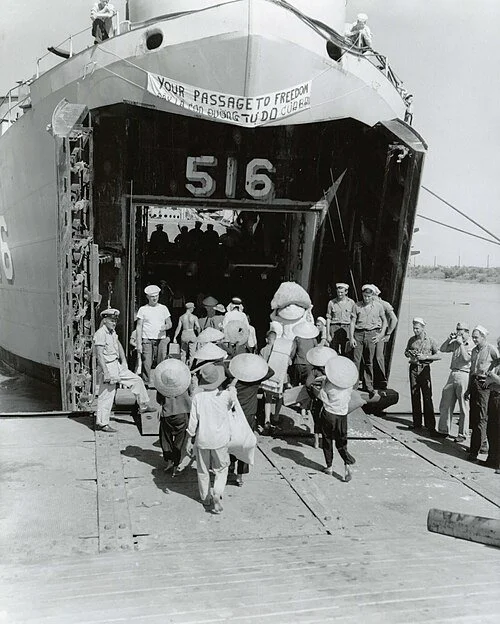
U.S. Navy photo "released" to Public Domain
Operation Passage to Freedom
A humanitarian/propaganda campaign in which the US Navy assisted in transporting 310,000 people from North Vietnam to South Vietnam after the communist Viet Minh succeeded in winning independence from the French in 1954. The US encourage Catholic Vietnamese to migrate through a leaflet campaign featuring slogans like “Christ has gone south” and “the Virgin Mary has left the North”.
Figures
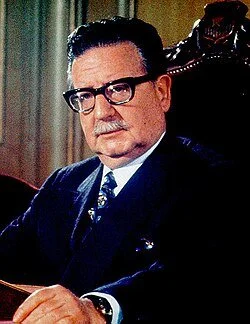
Official portrait, 1970
Official portrait, 1999
Salvador Allende
President of Chile, 1970-1973
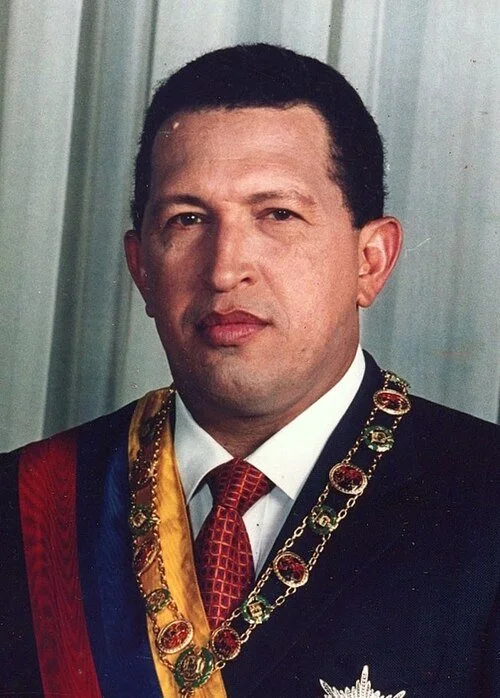
Hugo Chavez
President of Venezuela, 2002-2013
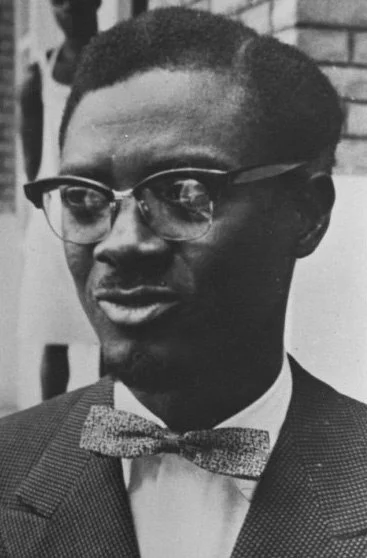
Unknown photographer
Patrice Lumumba
Congolese revolutionary and first Prime Minister of the Democratic Republic of Congo, June 24, 1960- September 5, 1960. Overthrown and assassinated following a coup by Joseph-Désiré Mobutu.
PROFILES




KATE MCDUFFFIE
ERIK SCHILLER
LEO LACAMERA
SANDIA COLEMAN
LEO LACAMERA (Sam, Drunk Enough to Say I Love You?) (he/him) is excited to be a part of this production. He's a regular performer in Comedy and Improv shows at the Newport and Annoyance theaters, but is always grateful for an opportunity to return to his theatrical roots. He would like to thank everyone involved in the production and you for coming to see it!
KATE MCDUFFIE (Stanek, Protest) (she/her) is a career arts administrator, part-time classical singer, occasional actor and avid volunteer. Formerly a performing arts educator, Kate directed her talented and amazing students in Antigone (Sophocles), Middletown (Eno), A Midsummer Nights Dream (Shakespeare), The Bear and The Proposal (Chekov) in addition to many performing arts showcases. She has been a proud facilitator with ABLE — Artists Breaking Limits and Expectations since 2019, currently serving on ABLE’s Program Advisory Council. Kate is also honored to serve on the Board of Directors at Remy Bumppo Theatre Company where she chairs the Engagement Committee.
ERIK SCHILLER (Guy, Drunk Enough to Say I Love You?) (he/him) a child of two biology professors, Erik studied English Literature and Cultural Anthropology at the University of Tennessee, Knoxville where he also received his initial training as an actor and writer. He has since performed roles on stage and in independent film and television — favorite past roles include Dromio (the one from Syracuse) in Comedy of Errors (Nashville Shakespeare Festival), Don in It's All in the Timing (Yellow Rose Productions), and Zombie-who-gets-an-axe-to-the-face in Ghosts and Zombies (Akvavit Theatre). He is the author of two plays, "The Mediums" and "The Murder In Miller's Court". Other areas of interest include bioethics, environmentalism and sustainability, the life and times of Shakespeare, and the history of radical and revolutionary politics.
IRIS SOWLAT (Director, Drunk Enough to Say I Love You?) is a Chicago-based director. She holds an MFA in Theatre Directing from University of Massachusetts Amherst (2024), where she directed Sarah Ruhl’s Orlando and Lauren Gunderson’s Emilie: La Marquise du Chatelet Defends Her Life Tonight. Most recently, she directed the Revolutionists for Violet Surprise Theatre, touring to 25 Chicagoland communities. In 2025, she directed Amy Crider’s Buddha’s Birthday (Lucid Theatre), The Book of Will for Triton College (as Adjunct Faculty), and Come Along for the Ride (Eco Logic). Additional Chicago directing credits include Romeo and Juliet (Accidental Shakespeare Company), Joan of Arc and Underworld Anthem (RhinoFest), The Days Are Shorter (PrideArts), ABCD (Piven Theatre), and Narratives of Achromatopsia and Turn That Thing Around (Chicago Fringe Festival), and three different sold-out fundraiser readings of Paula Kamen’s Jane: Abortion and the Underground. She has also worked with Northlight Theatre, About Face Theatre, American Theatre Company, Chicago Dramatists, Collaboraction, Broken Nose, Stage Left Theatre (former Artistic Associate), and many others. Iris is the Co-Artistic Director of Violet Surprise Theatre, founded with Allison Fradkin in 2019. In 2018, she was named one of Windy City Times’ “30 Under 30.” Find her on the web at www.IrisSowlat.com.
SOFIA MATZA (Stage Manager) (she/her) is a Chicago-based theater artist. She graduated from the University of Indianapolis with a degree in Theatre Production and a minor in Communication. During her time there, she worked on productions including The Taming of the Shrew (Assistant Production Manager), The Last Days of Judas Iscariot (Costume Crew), and In the Next Room (Assistant Stage Manager). She is passionate about collaborative storytelling, and the behind-the-scenes work that brings productions to life, and is eager to continue growing in theater production.
